When a potential client looks for a contractor, they are increasingly turning not to traditional search, but to AI platforms. Instead of opening a page with dozens of links, they ask a question in ChatGPT, Perplexity, Gemini, or DeepSeek — by voice or text, in plain natural language. For example: “Which agency specializes in SEO for construction companies?”
In this scenario, the user often gets not a list of websites, but a single ready-made answer or a short list of a few options. And if a company is not in that answer, for part of the audience it effectively does not exist. This is no longer a future scenario. It is the new reality of digital search, and it is forming right now.
What has changed in the search mechanism
In the past, a search engine showed a list of pages, and every website had a chance to be considered. The user opened several tabs, compared options, studied case studies, read reviews, and only then made a decision.
Today, AI search works differently. It synthesizes an answer based on the sources it considers reliable and relevant. This means that even a website with strong rankings in traditional search may receive no visit at all if the AI system decides to answer the user directly, without a click and without sending them to the site.
For businesses, this creates a new kind of competition: it is no longer enough to rank in search. It is now also necessary to be a source that AI systems are willing to cite and recommend.
Why this matters especially for B2B
A B2B buyer rarely makes a decision after the first touchpoint. Between the first moment of interest and signing a contract, there are usually weeks or even months: the market is researched, vendors are compared, internal approvals are collected, risks are assessed, and budgets are reviewed.
Previously, this path almost always started in a search engine. Now it increasingly begins with a question to an AI tool. The user is asking not just to find websites, but to help narrow down the choice right away:
- which agency specializes in SEO for medical clinics;
- who focuses on promoting construction companies;
- how to choose a PPC contractor for B2B;
- which agencies work with SaaS companies.
In other words, AI is increasingly becoming the first filter before a user ever reaches a company website.
Why AI traffic matters more than ordinary traffic
Even if traffic from AI platforms is still smaller than traffic from traditional search, its quality is often higher. A user arriving this way is no longer at the stage of general curiosity. They come with a more mature understanding of the task. The AI has already helped structure the market, define selection criteria, and narrow the list of options.
In effect, the company receives not a cold visit, but a warmer inbound lead. That is why presence in AI answers is no longer just a matter of reach, but a matter of lead quality and customer acquisition cost.
Why businesses need to act now
There is almost always a window of opportunity in the market when a new technology is already changing user behavior, but most companies have not yet adapted. That is exactly when long-term advantage is formed. The market is not overheated yet, and most companies are only beginning to realize that AI platforms are becoming a separate channel of attention distribution. Those who start working on this direction earlier will be able to accumulate authority and secure positions that will cost many times more later.
Why strong SEO does not guarantee AI citation
One of the most common mistakes is assuming that strong search rankings are enough to get included in AI answers. In practice, this is not the case.
It is important to distinguish between three directions:
- SEO — visibility in traditional search results;
- AEO — inclusion in quick and direct answers;
- GEO — citation and presence in generative AI answers.
Strong SEO helps, but it does not guarantee that a company will be named in a ChatGPT, Perplexity, or Gemini answer. AI platforms have their own selection mechanisms: they look not only at a page’s ranking position, but also at content structure, authority, consistency with other sources, freshness of the data, and the page’s technical accessibility.
For example, when working with the project doctor-dobriakov.com, our team achieved AI citation for the site within a few months. This did not happen through basic SEO alone, but through comprehensive refinement of the content structure, stronger expert presentation, improved page relevance, and closer alignment with the kinds of questions real users ask AI systems.
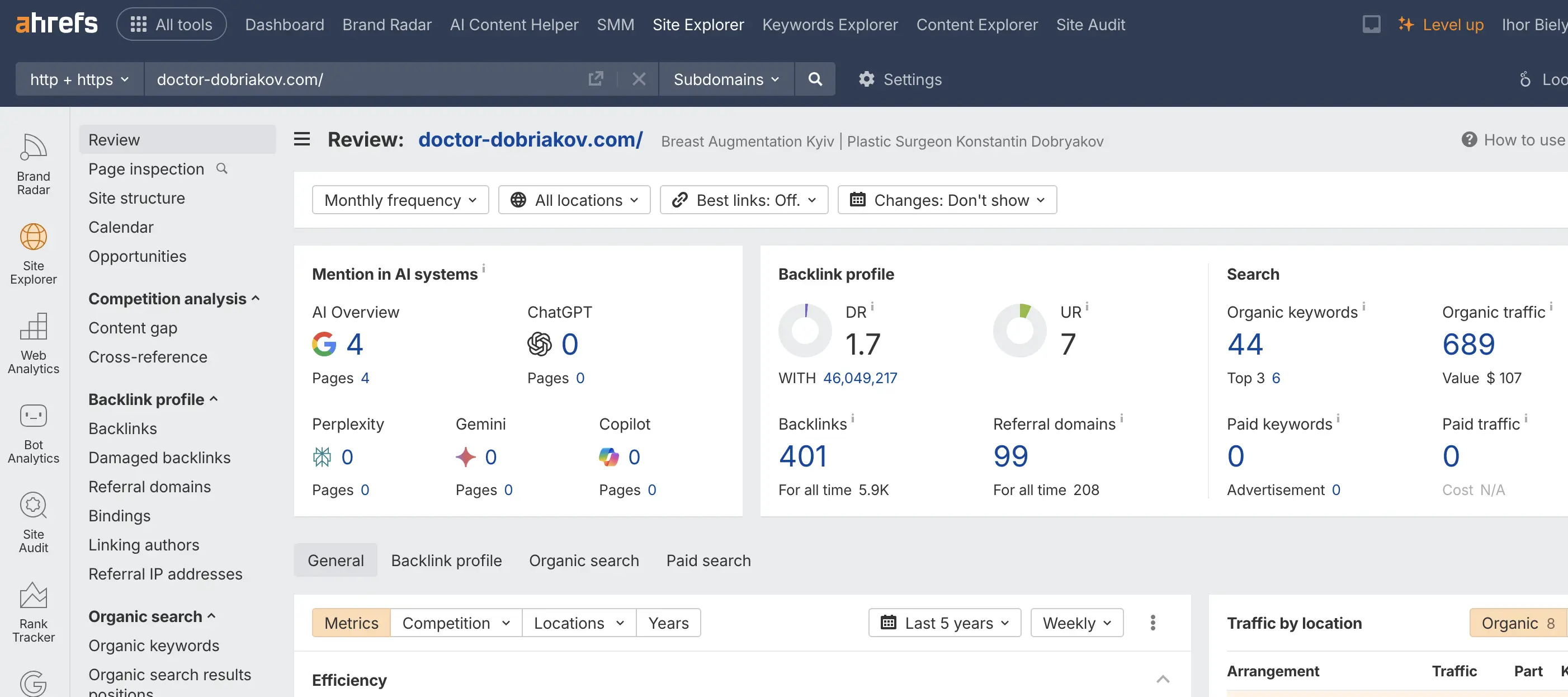
This case clearly illustrates the key point: even if a site already has a strong search foundation, that alone is not enough for AI visibility. For an AI system to start mentioning a company in answers, the content must be not only search-optimized, but also easy to extract, interpret, and cite within an AI-driven scenario.
What actually
1. Content structure
AI systems process content more effectively when the answer is given quickly and clearly. If the main point is buried in the middle or at the end of the text, the chances of being cited are lower.
That is why the following work especially well:
- clear headings in formats like “What is…”, “How to choose…”, “Why…”;
- FAQ blocks based on real client questions;
- short and specific answers at the beginning of sections;
- structured lists, tables, and comparisons.
A good example of this approach is our work with aiwiremedia.com. For media and content projects like this, it is especially important not just to publish articles, but to structure them so that they are understandable not only to readers, but also to AI systems. In such cases, the decisive factors are article structure, speed of delivering the key message, the presence of clear thematic blocks, and the overall editorial credibility of the source.
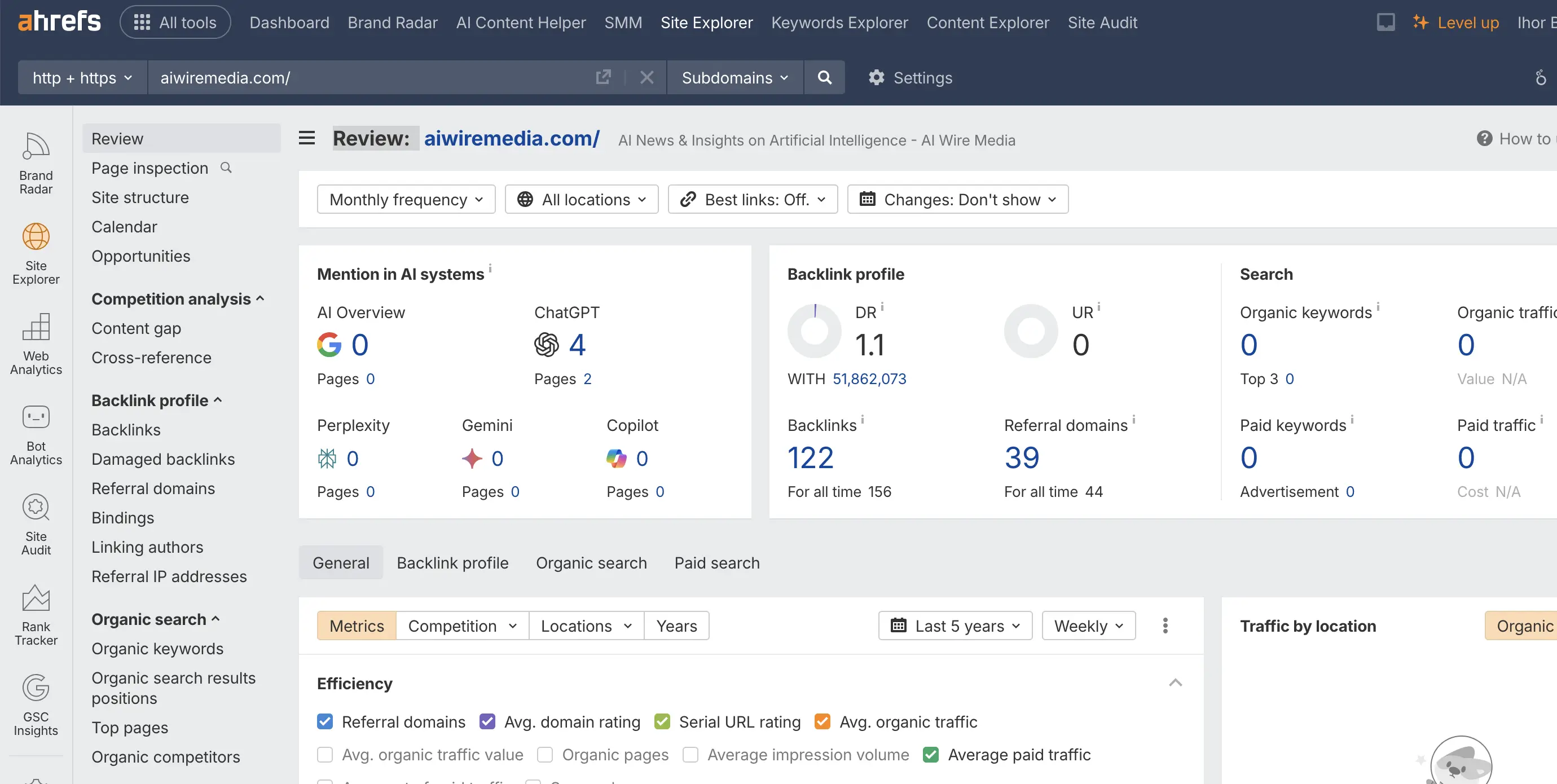
That is why, for projects of this kind, what wins is not just a “good article,” but a text that can be easily broken down by the machine into meaningful fragments. If a piece gives a clear answer, gets to the point quickly, and reinforces source authority, the probability of appearing in AI answers becomes significantly higher.
Put simply, AI platforms are more likely to cite not the longest pages or the most formally “optimized” ones, but the ones best suited to delivering an accurate, structured, and confident answer to the user.
2. Expertise and authorship
Content without an author and without confirmed expertise is perceived as weaker. If a piece is signed by a specialist with clearly stated experience, position, and professional specialization, this strengthens trust in the page for both users and AI systems.

That is why, for projects like Forex, strengthening expertise is not just an editorial improvement, but an important part of an AI-visibility strategy. The more clearly a site demonstrates professional depth, industry competence, and transparency of authorship, the higher the chance that such content will be perceived as a reliable source for citation.
3. Mentions on external platforms
AI platforms do not rely only on a company’s own website. On the contrary, it is often even more important how the brand is represented on third-party resources: in industry media, expert columns, interviews, reviews, rankings, and analytical publications.
That is why one strong expert publication on an authoritative platform can contribute more to GEO visibility than a series of posts in the company’s own blog.
4. Freshness of data
AI systems prefer up-to-date content. A piece with outdated figures and links looks less convincing than an updated page with new data, relevant examples, and current context.
5. Technical accessibility
If a page is poorly indexed, loads slowly, lacks a clear structure, or contains technical issues, it loses before the citation stage even begins. Basic technical quality remains a mandatory condition.
What needs to be done first
1. Check how AI systems see the company right now
The first step is to look at the company through the eyes of a user. To do this, open ChatGPT, Perplexity, and Gemini, and ask the same questions your potential clients actually ask.
For example:
- which agencies specialize in SEO for medical clinics;
- who promotes B2B companies in the SaaS sector;
- how to choose a PPC contractor for a construction company.
You need to see whether the company is mentioned at all, how it is described, which competitors are named nearby, and what sources the answer is based on.
2. Rebuild the key pages on the website
There is no need to rewrite the entire site at once. At the start, it is enough to rework 2–3 key pages that describe the company’s core expertise.
On those pages, it is important to:
- give the main answer in the first screen or first section;
- add FAQs based on real client questions;
- use numbers, case studies, and specifics;
- identify the author and their expertise;
- make the structure clear for both people and AI systems.
3. Mentions on external platforms
A company’s own website is no longer enough. For AI systems to perceive a company as a reliable source, the brand must be present not only on its own pages but also in the broader digital environment: on industry platforms, in sector publications, directories, reviews, rankings, and niche resources.
AI platforms evaluate not only the company’s website itself, but also how well the brand is reinforced by external signals. If the company is mentioned by third-party resources, if relevant platforms link to it, and if the brand is visible within the professional landscape, this strengthens its credibility as a source.
A good example of this type of task appeared in our work with client rebate.finance. At the stage of analyzing the external backlink and mention profile, it became clear that for this project the key issue was not simply the presence of links as such, but the quality and structure of the external environment. For AI visibility, what matters is not the number of random links, but how logically and thematically the site is embedded into its industry ecosystem.
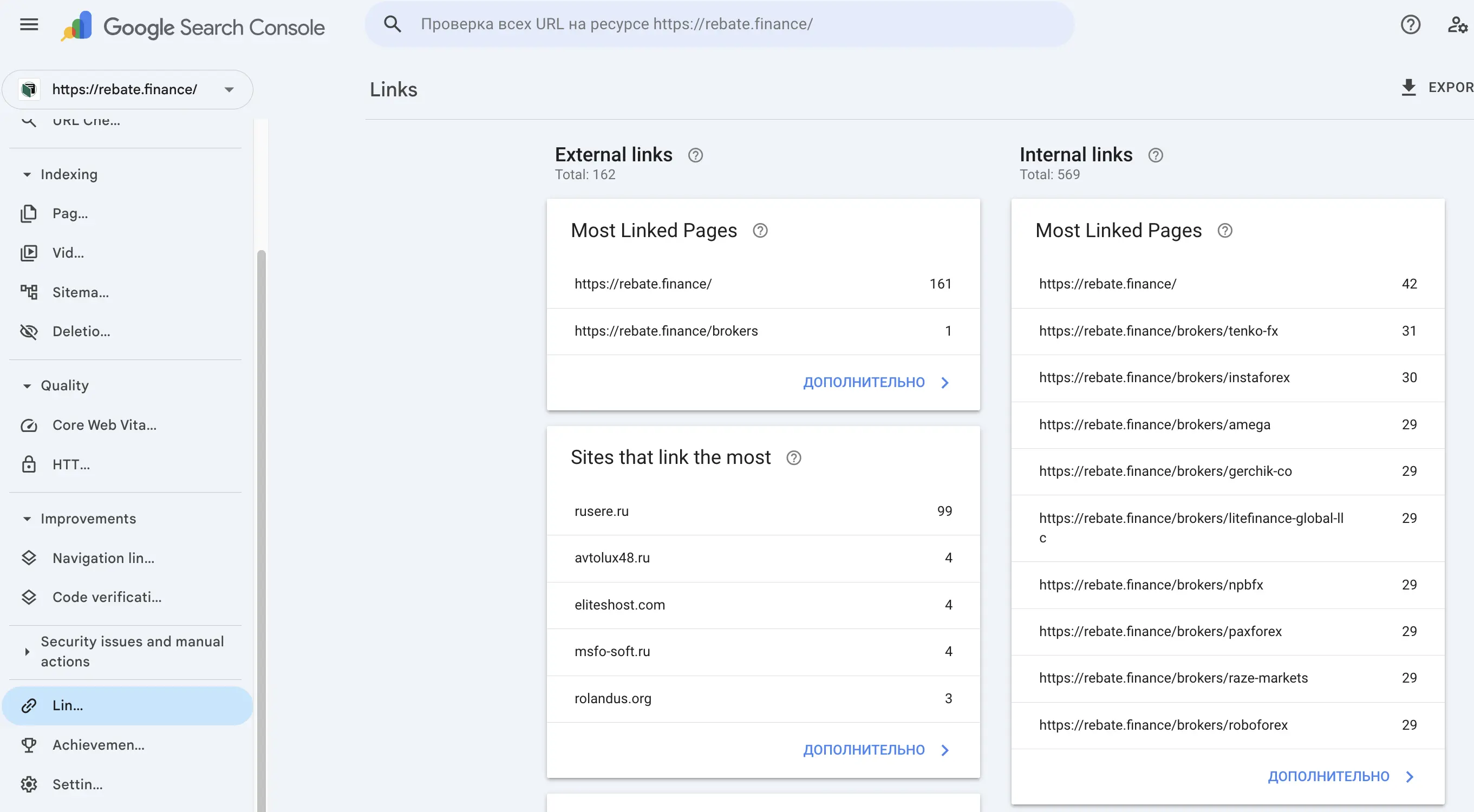
That is why, in these tasks, it is important not simply to grow link volume, but to build quality external signals that confirm the project’s expertise and topical relevance. For AI systems, this functions as an additional layer of trust: the brand starts to be perceived not as an isolated website, but as a participant in a professional market that is talked about and referenced by other resources.
The choice of platforms always depends on the niche:
- for IT and technology — профильные media and industry publications;
- for business and management — business media outlets;
- for marketing — professional media and expert platforms;
- for medicine, education, construction, and other industries — specialized resources with editorial control.
It is important not just to appear on external platforms, but to build presence exactly where AI systems find and use quality industry signals to form answers.
4. Track a new type of visibility
It is no longer enough to monitor only search rankings and organic traffic. A new metric is emerging: a company’s presence in AI answers.
That is why we recommend:
- tracking brand mentions in AI-platform answers for your key queries;
- analyzing visits from AI sources separately when they are passed into analytics;
- recording the dynamics: where the company is already appearing and where it is still absent.
Why delaying is risky
The history of digital marketing has repeatedly shown the same pattern: those who start working with a new channel early gain an advantage that later becomes extremely difficult and expensive to catch up with.
This was true for SEO, it was true for Telegram, and the same is happening now with GEO. While most companies are still just watching the changes, the market is not overheated yet. But once AI visibility becomes obvious to everyone, competition for citations and presence in answers will become much more expensive.
Put simply, it will still be possible to enter later, but the cost of entry will be many times higher.
GEO is not a one-time task, but a cumulative asset
Visibility in AI search is not built in a single day. It accumulates. Every strong expert article, every mention in an industry publication, every well-structured page on the website increases the probability that the brand will begin to appear in AI answers more frequently.
That is why GEO should be viewed not as a one-time setup, but as a long-term system for building brand authority in the digital environment.
Need help? We can build visibility in AI search
Our team helps companies not only grow in traditional search, but also adapt their digital strategy to a new model of information consumption in which ChatGPT, Perplexity, Gemini, DeepSeek, and other AI platforms play an increasingly important role.
We help with:
- assessing current AI visibility of the brand;
- rebuilding key pages for AEO and GEO;
- strengthening expert presence on external platforms;
- preparing content that is understandable for people and usable for AI systems;
- building a systematic strategy for presence in AI answers.
If you want to understand how your company appears in AI search right now and what needs to be done so that it starts being cited and recommended, submit a request for an audit. We will review the current situation and provide a concrete action plan.