AEO and GEO: What’s the Difference and Why They’re Really the Same Strategy
AI search is changing how people look for and find information. But along with that, marketers now face a new question: what should we even call the process of optimizing for search powered by artificial intelligence? And since marketers love coming up with new terms, there are already quite a few options.
Today, the industry uses terms such as AEO (Answer Engine Optimization), GEO (Generative Engine Optimization), AIO (AI Search Optimization), and other variations. For example, La-Marketing.us adopted the term GEO in its concept in December 2025. But now, in our opinion, that is not the most effective name.
We believe GEO is a weak term. That is especially ironic because marketing is supposed to be good at naming things. Why is GEO a poor choice? We will break it down below, but in short, the term lacks clear uniqueness and is difficult to anchor to one specific meaning.
Just try typing GEO into Google. The problem becomes obvious immediately.
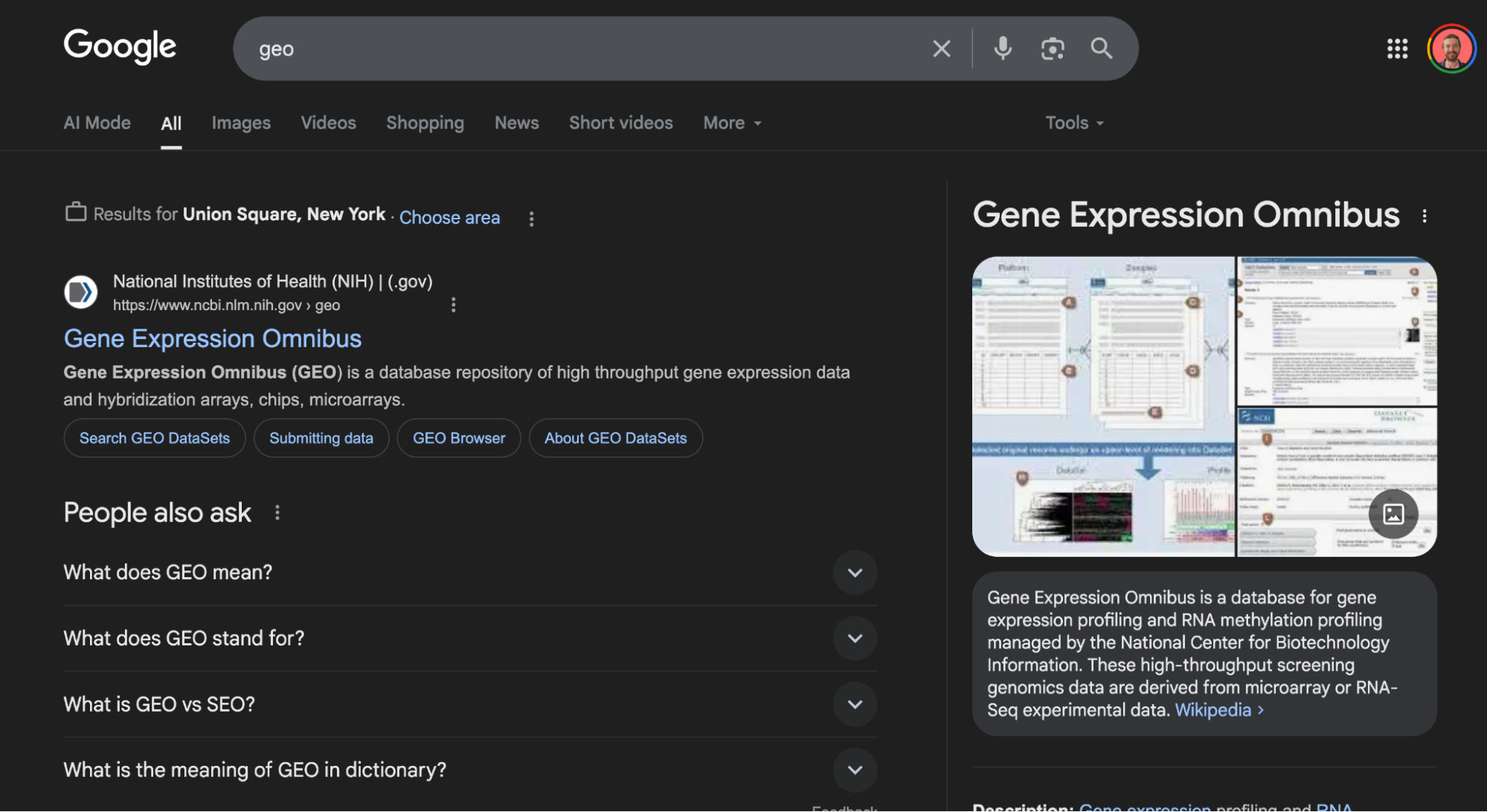
When you search for it, you will see a huge number of results that have nothing to do with optimization for AI search. At the top, there may be authoritative websites, encyclopedic materials, knowledge panels, and many other meanings of the acronym. In other words, the term is overloaded with unrelated associations from the start.
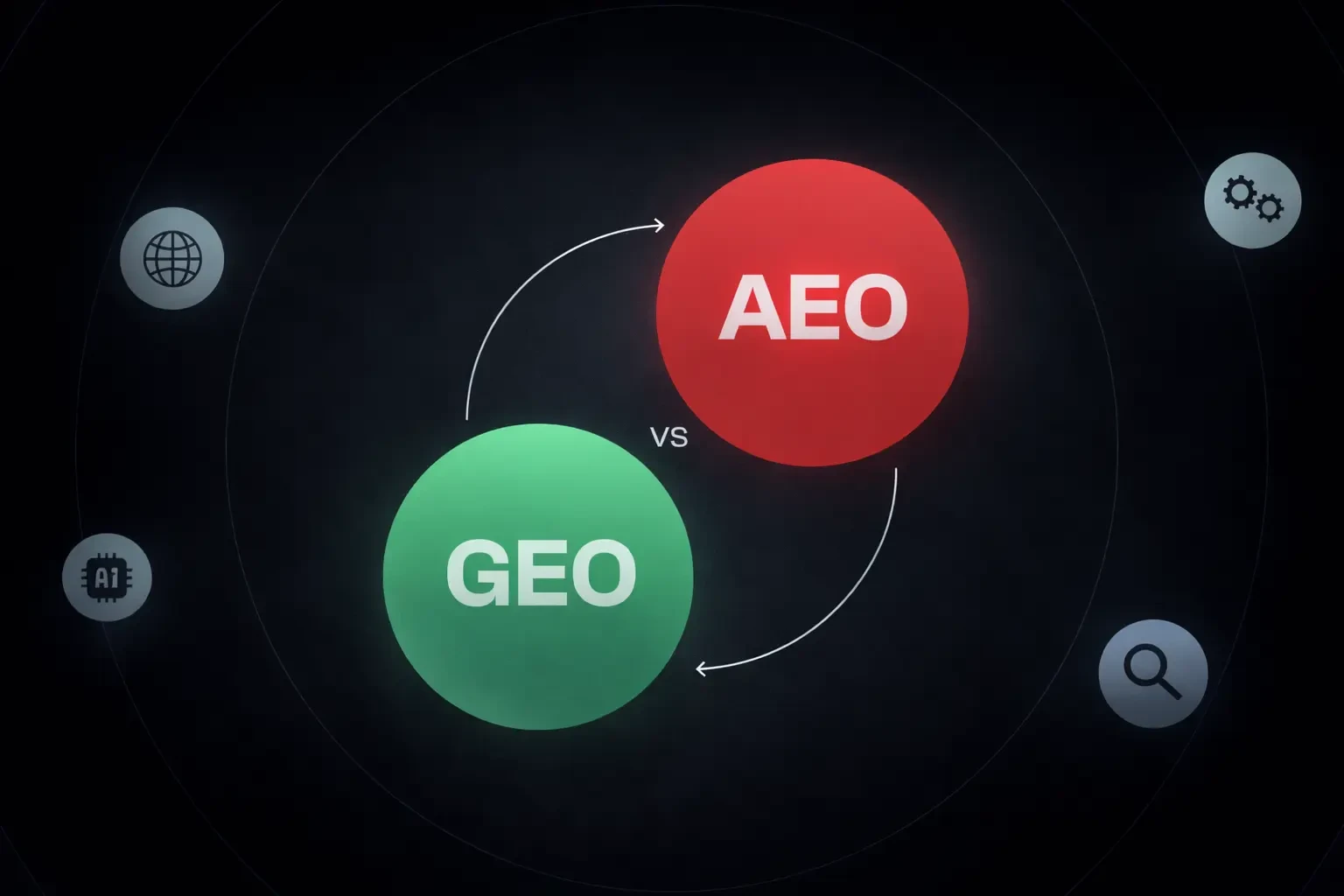
At the same time, there are still articles claiming that GEO and AEO are different approaches and that each supposedly has its own separate role. In our view, that is a mistaken interpretation.
Despite the arguments around terminology, the core idea has not changed: the goal remains the same, to make sure your content appears to users as a trustworthy and relevant answer to their question.
That is exactly why it makes more sense for SEO specialists to use the term AEO, or Answer Engine Optimization. It is more precise, easier to understand, and better reflects the actual concept. Unlike GEO, this term at least immediately explains what it is about.
AEO and GEO: Two Terms, One Approach
AEO, or Answer Engine Optimization, emerged as an evolution of search optimization when Google began actively showing expanded answers, featured snippets, and knowledge panels. The idea was simple: prepare content in a way that allows the search engine to take it and use it as a direct answer to a user’s query.
GEO, or Generative Engine Optimization, is a newer term used to describe optimization for AI-powered search tools and generative interfaces such as Google SGE, Bing Chat, and ChatGPT. But neither AEO nor GEO can be fully equated with traditional SEO.
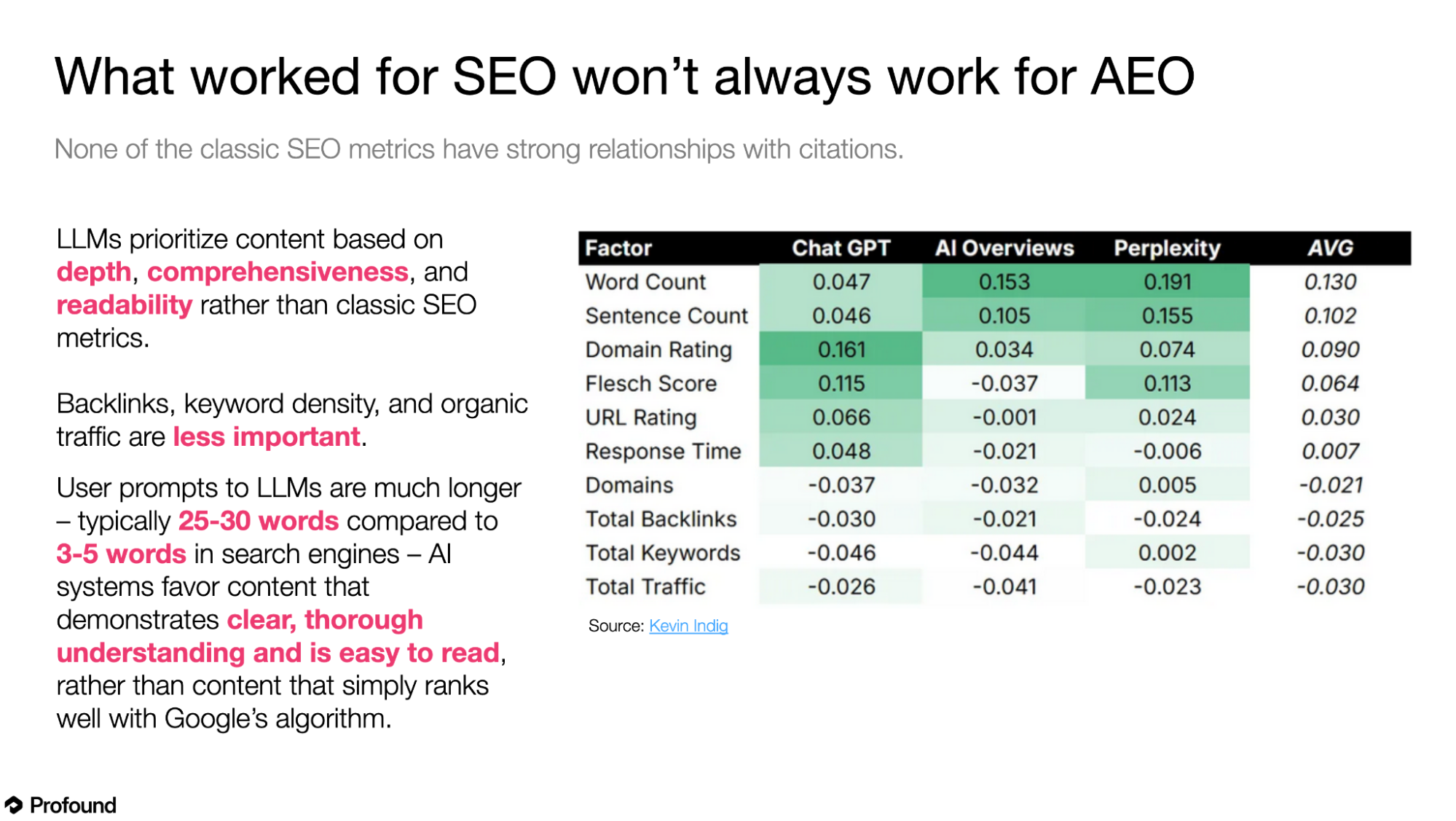
Research shows that there is not much overlap between standard Google search results and ChatGPT answers. And this is confirmed not only by internal company observations, but also by industry experts who increasingly point to the differences between traditional SEO and optimization for AI-generated answers.
For example, Kevin Indig’s analysis showed that the factors influencing visibility in LLM systems differ significantly from traditional search ranking factors.
When it comes to the practical side of AI Search optimization, SEO expert Aleyda Solis has put together a strong checklist of recommendations on what truly deserves attention. Below are the key directions.
Key AEO Optimization Tactics
|
Tactic |
Why It Matters |
|---|---|
|
1. Optimize at the level of semantic content blocks |
AI search systems do not work with entire pages as a whole. Instead, they process individual text fragments that are broken into semantic blocks or chunks. The system then selects the most relevant parts and uses them to build an answer. That is why every section of your content should be self-contained, clear, and valuable on its own. |
|
2. Optimize for final answer assembly |
AI systems often generate a single answer by combining information from multiple sources. That means your content should be logically structured, easy to extract, and able to fit naturally into a synthesized response. |
|
3. Optimize for citation-worthiness |
For an AI system to cite your content specifically, it needs to appear trustworthy, accurate, current, and well-structured. Not every fragment included in an answer gets credited. Citations have to be earned through quality and trust. |
|
4. Cover the topic broadly and deeply |
Modern AI search engines can break down a complex user query into several уточняющих subqueries across subtopics, intents, and different angles of analysis. Then they gather information for each one and merge it into a single answer. That is why sites that cover a topic deeply and systematically outperform those that rely on one shallow page. |
|
5. Support multimedia content |
AI search increasingly uses not only text, but also images, tables, charts, video, and other formats. This gives brands an additional opportunity to improve visibility through more visual, useful, and user-friendly content. |
Why the Term AEO Looks Stronger
Clarity: AEO, or Answer Engine Optimization, immediately explains the essence of the approach: it is optimization for answers. GEO sounds more abstract and, without context, does not really explain what it means.
Distinctiveness: AEO is much easier to establish within the professional field. GEO overlaps with geography, geology, geotargeting, and many other meanings, which makes it much weaker as a brandable term.
Continuity: AEO logically extends the familiar framework of SEO. In practice, many specialists are already doing this, even if they do not always call it that. In this sense, the term helps explain the new practice as an evolution, rather than making it seem like the market suddenly invented something completely separate.
Future relevance: As long as users continue asking questions and looking for answers, the concept of answer engines remains clear and viable. The term generative engines may eventually feel outdated, especially if generative search simply becomes the norm.
The Bottom Line
The best way to gain visibility in the new search environment is to provide users with the best answer wherever they are looking for it. Whether you call it AEO, GEO, or next-generation SEO, the task itself does not change.
This is not about two different strategies, but one unified approach. At its core is high-quality, structured, trustworthy, and useful content that can serve as an answer in traditional search, voice assistants, AI bots, and generative interfaces.
Yes, the debate over terminology will continue. That is normal in any fast-growing industry. But in practice, the name matters less than the result.
Focus on the constants: people have questions, and they look for answers in search engines, voice assistants, and AI services. If your content consistently helps, explains, and builds trust, it is the content that will gain visibility.
Everything else, algorithms, interfaces, names, and acronyms, is secondary. What matters is that your brand becomes the answer users see first and trust most.
In a world built around questions and answers, the winners are those who know how to be useful, clear, and visible across every search scenario.
Contact us, and we will bring your website or project to the top of Google search results and AI platforms, including ChatGPT, Bing, and others. We work not only with classic SEO, but also with the modern AEO (Answer Engine Optimization) approach, which helps your content become a direct answer in AI search - Learn more: la-marketing.us