
Development and Promotion of the LabnClinic Medical Website
LABNCLINIC - is a clinic and laboratory of molecular medicine: tests for trace elements, vitamins, amino acids and biochemistry, doctor consultations, and products for correcting deficiencies. We brought together a public site for patients and partners and an internal lab application that automatically visualises results.
About the client
The Molecular Medicine clinic works at the intersection of bioelementology and clinical practice: it studies macro- and micro-elements, vitamins, amino acids, antioxidant status, and biochemical markers in blood, hair, nails, saliva, and urine.
The scientific lead is Margarita G. Skalnaya, MD, PhD, Professor, a specialist in bioelementology and molecular medicine. Since 2021 she has run the centre as CEO while continuing her clinical practice.
The brief
Build a site that works equally well for a patient, a doctor, and a corporate client: easy to find the right test, understand how to prepare, see the price, book a visit or order remote sample collection in the regions. In parallel, develop an internal lab application that handles reference-range comparison and produces ready-made charts.
Core scope:
- a clear architecture for the clinic and the lab, split by audience;
- a test catalogue with categories, prices, sample types, and preparation rules;
- a remote sample collection flow for patients outside Moscow;
- SEO architecture for medical queries with YMYL/E-E-A-T in mind;
- an internal module for processing and visualising lab results;
- responsive layout and booking forms at every key step.
Challenges
The main one was the volume and complexity of medical content. Dozens of tests, different sample types, specialised terminology, separate paths for patients, doctors, and corporate clients. The job was to present all of this so that a non-medical visitor could figure out, in a couple of clicks, which test they need and what to do next.
On top of that: a mixed audience (Moscow and regions), the need to connect the test catalogue with deficiency-correction products, and to embed lab software with deviation charts into the workflow.
Research and preparation
Before design we mapped the services, research areas, and user scenarios. Four primary paths emerged: "check the price of a test", "prepare for sample collection", "choose a check-up", "order remote testing". Each became an entry point on the site.
Site structure
Editorial, commercial, and clinical blocks are kept separate so that each audience reaches its section by the shortest route.
- Home;
- About the laboratory and the clinic;
- Doctors;
- Tests;
- Products;
- For patients;
- Partnership;
- Promotions;
- Blog;
- Contacts.
Test catalogue
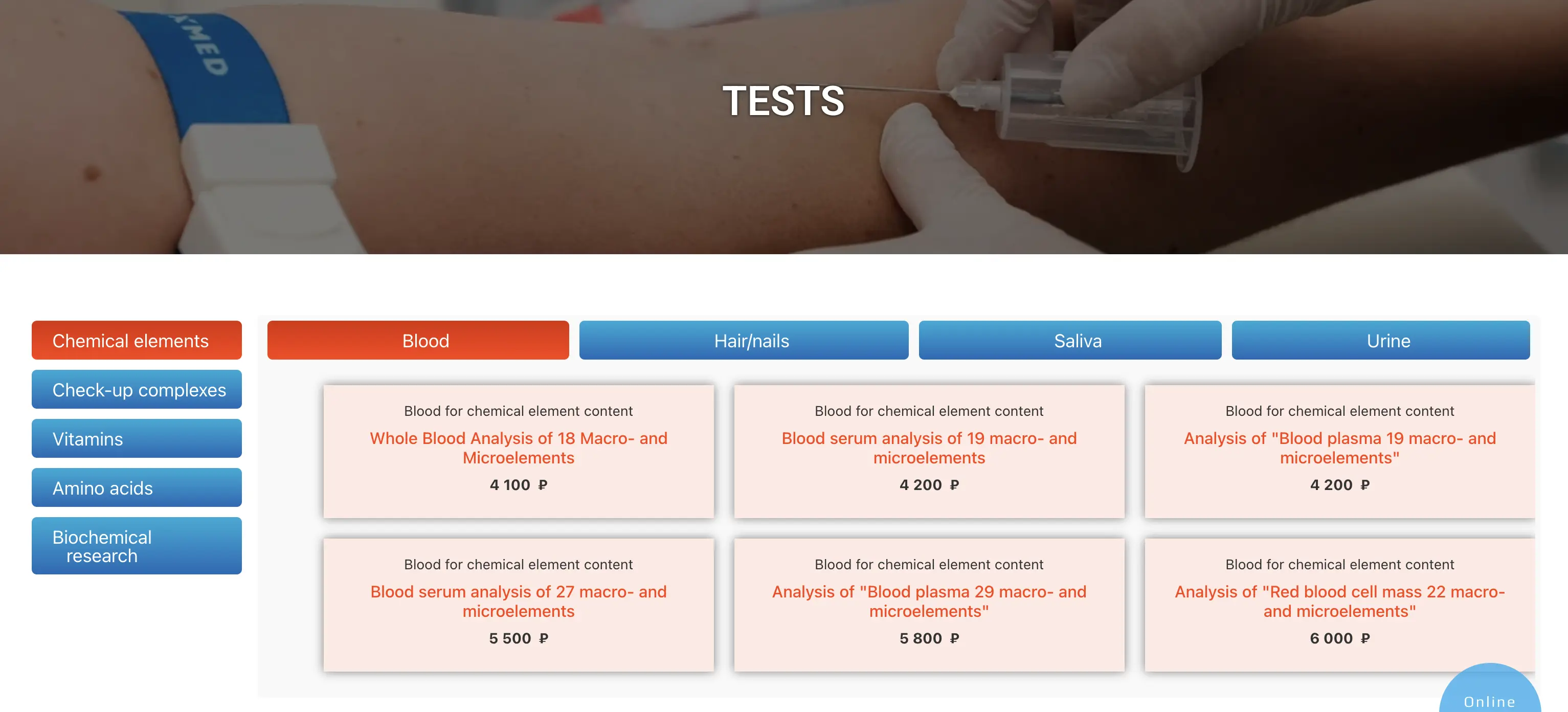
Instead of one long list, the catalogue is grouped by direction. The patient instantly sees which section to look in.
- chemical elements;
- check-up packages;
- vitamins;
- amino acids;
- biochemistry;
- blood, hair, nail, saliva, and urine studies.
Each test card carries a description, price, sample type, and preparation rules.
Research areas
We built dedicated pages for every key programme — from a whole-blood panel of 18 macro- and micro-elements to a 40-element hair analysis and a serum amino-acid profile. Among them:
- whole blood, serum, plasma, and red-cell mass for macro- and micro-elements (18, 19, 22, 29 markers);
- hair on 25, 33, and 40 elements; urine on 17 elements;
- vitamins D, B12, C, A, E;
- serum amino acids, ferrokinetics, ferritin;
- biochemistry: glucose, creatinine, urea, bilirubin, ALT, AST, lipid profile;
- HbA1c, complete blood count with ESR, C-reactive protein.
A separate block covers integrated programmes: "Healthy Lifestyle", "Extended Check-up", "Reproductive Health", "Alopecia", "Core Deficiency Check-up", and "Element Screening".
The lab application
The site takes bookings; the application processes results. A staff member enters the values, the system compares them against reference ranges, flags deviations, and assembles charts. Especially useful when there are dozens of parameters and visual assessment becomes unreliable.
The application is configured for every working area of the clinic:
- iron, ferritin, transferrin;
- zinc, copper, selenium, magnesium, calcium, potassium, sodium, phosphorus, manganese;
- vitamins D, B12, B6, B9, A, E, C;
- lipids: cholesterol, LDL, HDL, triglycerides; glucose;
- ALT, AST, bilirubin, creatinine, urea;
- amino acids: leucine, isoleucine, valine, glycine, arginine, tyrosine;
- antioxidant and inflammation markers.
Each marker has a defined norm, minimum, maximum, and unit. The output is not a wall of numbers but a clear report with deviations highlighted.
Charts and visualisation
The application produces several view types so that doctors don't have to interpret raw values.
- bar charts for trace elements;
- line charts for marker dynamics across visits;
- patient result vs. reference range comparison;
- colour coding for deficiency and excess;
- grouping by vitamins, minerals, and biochemistry;
- summary table of deviations;
- report export and print.
For a 40-element hair analysis, the application generates separate charts for zinc, copper, magnesium, calcium, selenium, and iron. For a vitamin profile — D, B12, B6, B9, A, E, C. For biochemistry — glucose, cholesterol, creatinine, liver enzymes. Manual reference checking is gone.
UX/UI
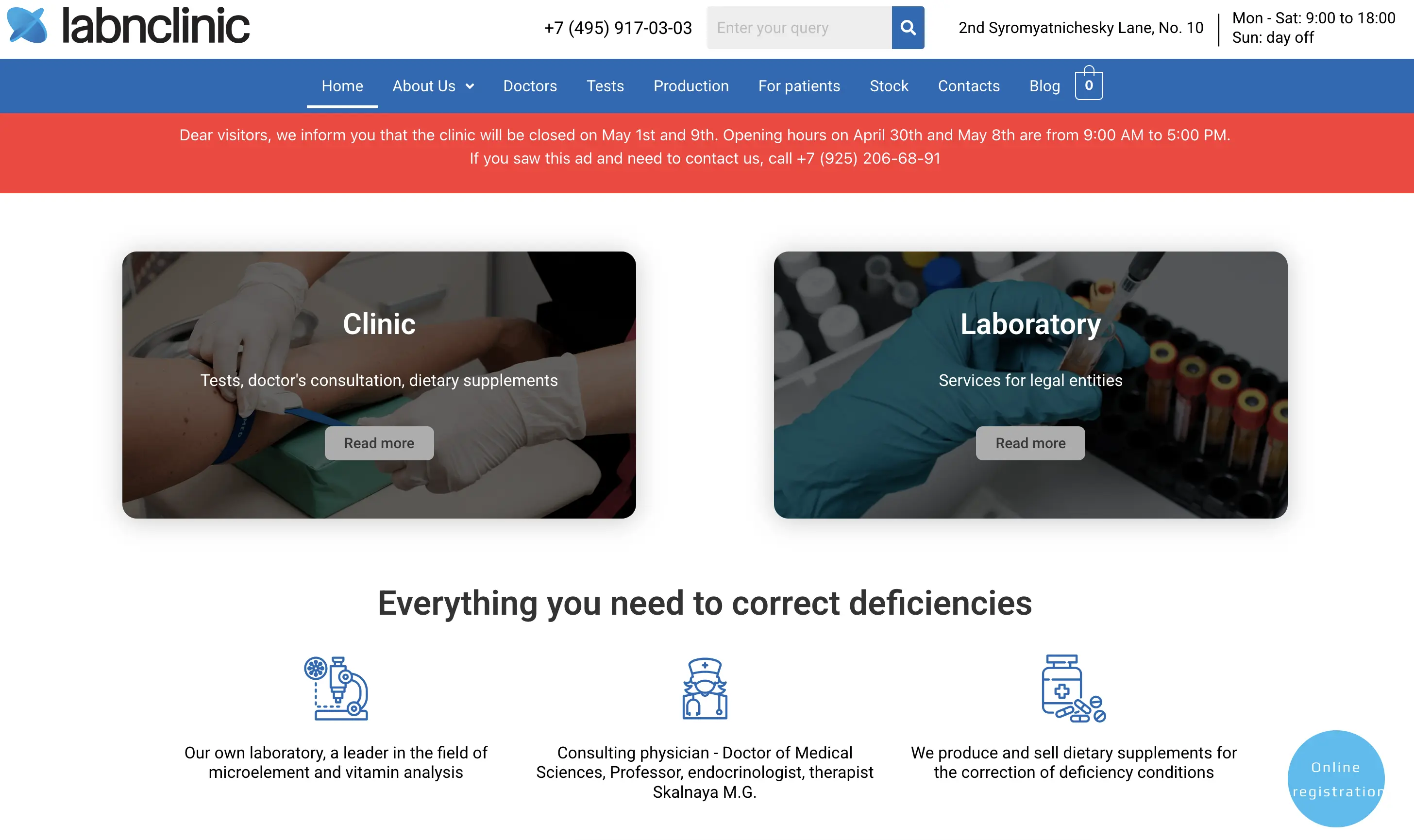
The design is built on "trust through calm": a clean grid, restrained palette, simple cards, and accents only where they push the user to act. The home page exposes quick entries to the clinic, the lab, the catalogue, consultations, and products.
The same visual language carries across pages for the lab and the clinic, doctor profiles, individual tests, products, promotions, the blog, the patient section, and contacts.
"For patients" section
It closes the typical pre-call questions: booking, preparation, sampling rules, on-site visits and remote collection, contacts. Fewer routine calls to reception — more time for substantive ones.
Products
The section is woven into the patient journey: test → consultation → recommendation → deficiency correction. Not a separate shop, but a logical continuation of the medical part.
SEO
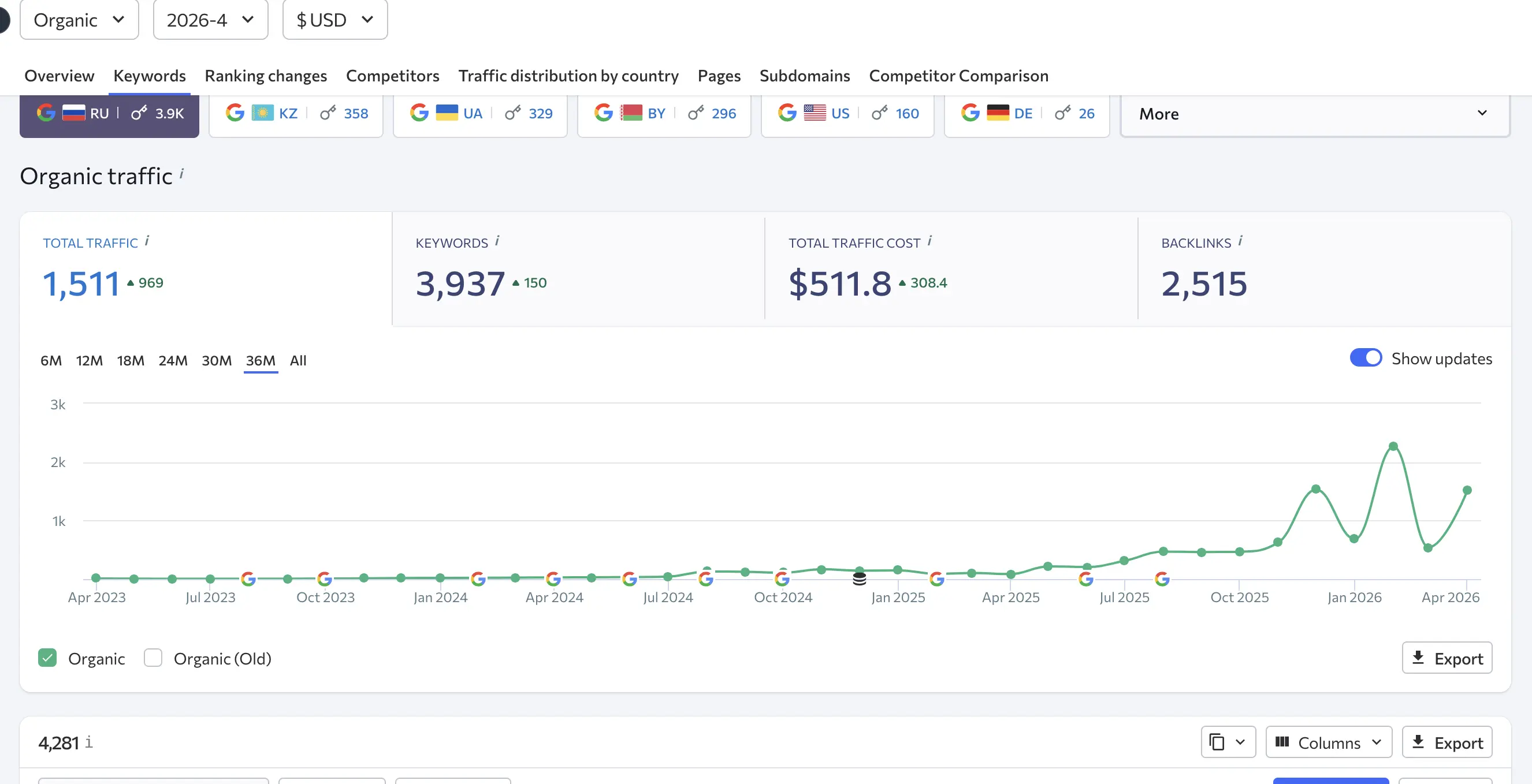
We promote not just the home page but every landing: individual tests, check-up programmes, the clinic and lab pages, and the blog.
- structured landing pages and catalogue categories;
- Title, Description, and H1 tuned for medical semantics;
- pages optimised for vitamins, micro-elements, and biochemistry;
- internal linking between tests ↔ articles ↔ check-ups;
- SEO blocks for integrated programmes and remote sampling;
- strengthened commercial signals: prices, contacts, hours, forms.
The keyword core was built around the most demanded queries: hair analysis, ferritin, vitamin D, blood biochemistry, amino acids, and check-up packages.
YMYL and E-E-A-T
Medical content needs trust, not just traffic. Search engines and patients have to see real specialists and verified material behind the site.
- expertise and credentials of Prof. Skalnaya brought to the surface;
- dedicated pages for the clinic, the lab, and the doctors;
- materials on preparation, sample types, and result interpretation;
- visible address, opening hours, and contact forms;
- complex terms split between patient-friendly explanations and the clinical layer;
- the blog designed for expert content, not short SEO posts.
Responsive version
Most patients arrive from a smartphone, so the mobile version isn't a "shrunk-down copy" but a separate scenario: the menu, catalogue, test cards, forms, map, and blog were redesigned for the thumb and a narrow screen.
What we built — the technical side
- information architecture for medical services;
- test catalogue with categories and filters;
- pages for individual tests and packages;
- responsive layout;
- booking and contact forms;
- promotions section and blog;
- doctor profiles and product cards;
- internal lab application;
- charting module for results;
- report export and print;
- SEO structure for ongoing promotion.
Results
The client got not a business-card site but a pair: a public-facing resource and a working internal tool. Indicative figures after launch:
- over 120 lab studies systematised;
- catalogue split by category and sample type;
- check-up programmes and promotions added;
- internal lab application with charts in production;
- result processing time down by roughly 35%;
- fewer manual errors in interpreting markers;
- faster patient report preparation;
- site enquiries up by roughly 28%;
- average page depth grew from 1.6 to 2.7;
- users now move from the catalogue to contact forms more often.
Takeaways
On LABNCLINIC.RU we combined three jobs: making complex medical content understandable for patients, convenient for clinic staff, and rankable for search engines. The lab module adds a separate layer of value: it removes the routine number-crunching and turns results into clear charts for trace elements, vitamins, amino acids, and biochemistry.
If your clinic, laboratory, or medical centre needs a site with a test catalogue, YMYL-aware SEO, responsive design, and internal staff tooling — get in touch. We'll build a project that works for patients, doctors, and the business.
LA Marketing Portfolio: Website Development & Promotion
Below are 30+ selected projects out of 750+ completed cases. Our main focus is website development, promotion and SMM for businesses in the US, Europe, and worldwide. We deliver solutions for real estate, online services, e-commerce, and niche markets.
Beyond Websites: Real Estate, Healthcare, SMM & More
Most projects are not published online. Contact us for portfolio examples in real estate (photo/visualization), healthcare, SMM, and education. We also manage SMM and digital growth for brands in narrow segments.
Need a modern website or online promotion? Contact LA Marketing