
Over 15 years in SEO, our team has been approached by hundreds of website owners with the same painful question: why is a website losing traffic if everything used to work fine before? The pattern is usually the same: yesterday the site had 500 visitors a day, today it has 150, and next week it may be down to 40. Along with traffic, calls, leads, and sales begin to decline, dependence on paid ads grows, and customer acquisition costs rise.
In this article, we have collected 12 of the most common reasons why website traffic drops based on what we regularly see in practice. No filler, no theory for theory’s sake — only real-world SEO scenarios.
Where to start: two basic diagnostic questions
Before looking for someone to blame or changing strategy too aggressively, it is important to answer two questions:
First: did traffic drop only for your site, or across the entire niche?
To check this, it is worth reviewing demand trends for your main commercial and informational keywords in Yandex Wordstat or similar keyword trend tools. If the market as a whole has declined, the issue may be seasonality or a shift in demand rather than the website itself.
Second: was the drop sharp or gradual?
A sharp decline within 1–3 days usually points to a filter, deindexation, or a technical issue. A gradual decline over several months is more often tied to outdated content, stronger competitors, reduced page relevance, or algorithm changes.
Only after answering these two questions does it make sense to move on to specific causes.
Reason 1. Technical issues on the website
One of the most common reasons for traffic loss is simple technical problems. Sometimes a site loses rankings not because of content or competition, but because search engines cannot process it correctly.
Here is what should be checked first:
- the
robots.txtfile — make sure important sections, CSS, or JS are not blocked; sitemap.xml— confirm that the sitemap is up to date and includes all important pages;- page loading speed;
- Core Web Vitals metrics;
- mobile usability and correct display on smartphones;
- SSL certificate validity and the absence of mixed content;
- 404 errors and broken internal links;
- duplicate pages:
www / non-www,http / https, with and without a trailing slash.
Even a relatively small issue with indexing or rendering can lead to a noticeable drop in visibility.
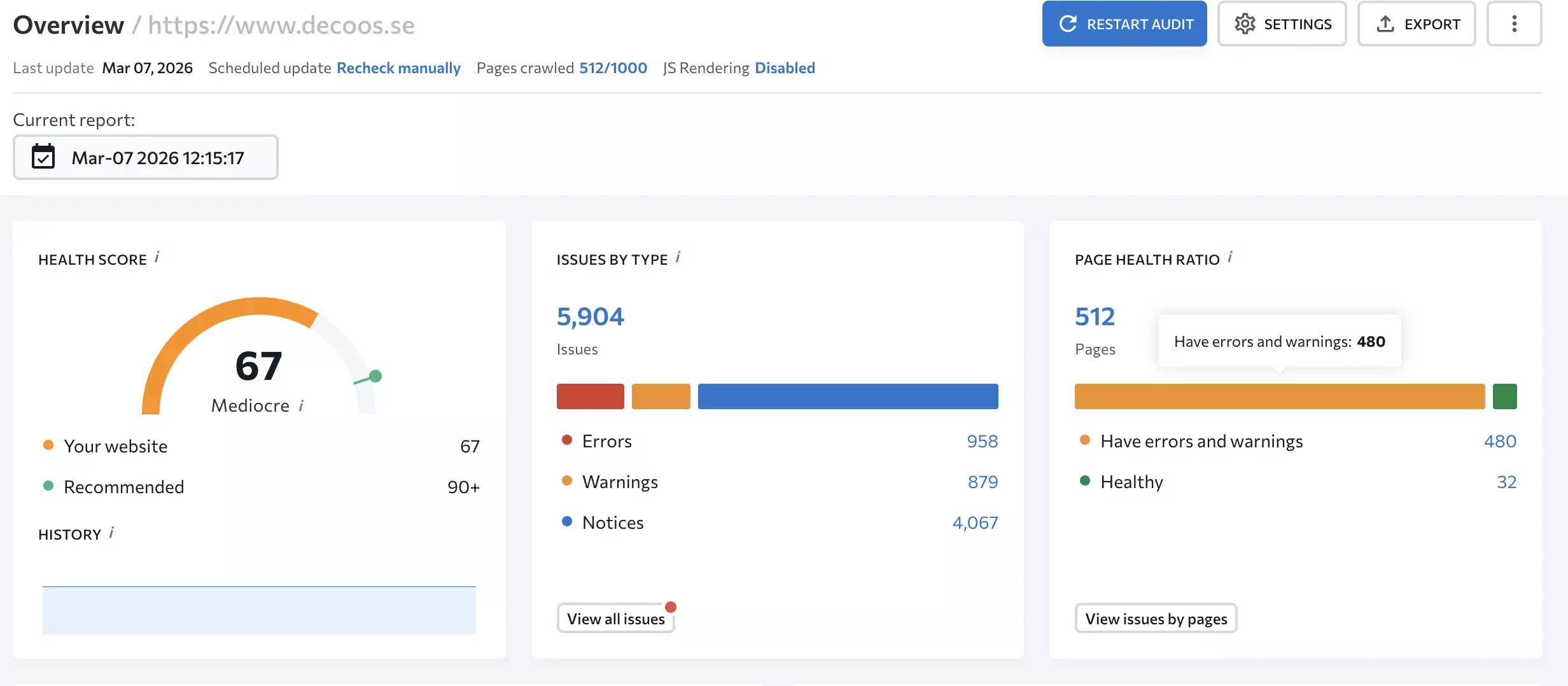
In practice, such problems are found even on visually polished and active commercial websites. For example, representatives of Decoos came to us after technical issues were identified on their website that directly affected indexing, page rendering, and the project’s overall SEO stability. From the outside, the site looked perfectly functional, but internally there were issues preventing search engines from processing the content correctly and limiting its organic traffic potential. This is a typical situation: the business sees a nice-looking website, while the search engine sees a set of technical limitations that gradually reduce rankings and traffic over time.
Reason 2. Yandex and Google algorithm updates
Search engines regularly update their ranking algorithms. Over the past few years, Yandex has significantly increased its requirements for content quality, behavioral factors, and page usefulness. Google, in turn, continues to roll out Core Updates, Helpful Content Updates, and Spam Updates.
Signs that a site may have been affected by an update include:
- the decline started on a single day;
- not just one or two pages dropped, but entire sections;
- SEO communities and industry blogs are actively discussing a new wave of changes.
In such situations, we do not recommend making rushed changes in the first days. Sometimes algorithms are still being adjusted and part of the lost visibility returns. But if the situation does not stabilize after a few weeks, a full audit is needed.
Reason 3. Search engine filters and penalties
If traffic dropped sharply and by several times, there is a high probability that the website has been affected by a search engine filter or penalty.
In practice, the most common cases include:
- Baden-Baden — for over-optimized text;
- Minusinsk — for purchased SEO links;
- AGS — for weak, templated, or low-value content;
- penalties for manipulating behavioral factors;
- affiliate filters — if multiple similar sites are being promoted within the same niche.
On Google’s side, issues are usually related to poor link quality, weak content, or insufficient overall site value.
In our experience, a significant share of sudden traffic collapses is tied to penalties that site owners often do not even realize exist.
Reason 4. Old and ineffective content
One of the most underestimated reasons for traffic decline is a large number of outdated pages that no longer provide value either to users or to search engines.
If a site has 500 pages, but only 50–100 of them generate traffic and engagement, the rest of the weak content can start dragging the entire project down. This is especially common on blogs, older corporate websites, and content-heavy projects.
In most cases, there are only two real solutions:
- update and rewrite old materials;
- remove weak pages and set proper redirects to relevant, up-to-date pages.
Reason 5. Worsening behavioral factors
If users leave the page quickly, do not interact with the site, return to search results, or fail to find the answer they expected, rankings begin to decline.
The main causes of worsening behavioral factors are:
- an outdated or untrustworthy design;
- intrusive pop-ups, widgets, or ads;
- slow loading speed;
- outdated or superficial content;
- stronger offers from competitors.
It is important to understand that it is not traffic itself that affects rankings, but the quality of user behavior that this traffic creates.
Reason 6. Loss of page relevance
Search intent changes constantly. A page that ranked well as a commercial landing page a year or two ago may gradually start losing to informational articles, reviews, listicles, or video results.
To diagnose this issue, we recommend:
- taking the core queries that used to bring traffic;
- reviewing the current search results;
- identifying what type of pages now dominate the top positions;
- comparing them with the pages on your own site.
If your page format no longer matches current search expectations, it loses relevance and starts to drop.
Reason 7. Link profile problems
The link profile remains an important signal in how search engines evaluate a website. Problems can arise both from overly aggressive link buying and from the sudden loss of older backlinks.
Common issues include:
- an unnaturally fast spike in backlinks;
- links from irrelevant or spam-heavy donor sites;
- a large number of links dropping out of the index;
- negative SEO attacks from competitors.
If a link profile looks unnatural, it almost always affects search visibility.
Reason 8. Competitors getting stronger
SEO is a constantly competitive environment. Even if you did not make any obvious mistakes, traffic can still decline simply because competitors have started doing a better job:
- expanding site structure;
- improving content;
- strengthening commercial ranking factors;
- upgrading product and category pages;
- expanding keyword coverage.
If the decline has been gradual over 6–9 months, this is one of the most likely scenarios.
Reason 9. Seasonality and external market factors
Not every drop is a problem. In many niches, traffic naturally fluctuates due to seasonality, changes in demand, market cycles, or broader economic conditions.
Seasonality should be checked not month-over-month, but year-over-year. If the current month is close to the same period last year, there may be no real problem at all.
Reason 10. Organic traffic shortage in search results
Today, even high rankings do not guarantee the same number of clicks as before. Yandex and Google continue to fill search results with their own features:
- ads;
- maps;
- marketplace blocks;
- instant answers;
- video results;
- recommendation modules.
As a result, users reach the classic organic results less often. This means that even a number-one ranking may now generate far fewer clicks than it did a few years ago.
Reason 11. Untargeted traffic and semantic targeting mistakes
Sometimes the issue is not that there is too little traffic, but that the traffic is the wrong kind. For example, a commercial website may attract users through informational queries that do not convert into sales and at the same time weaken behavioral metrics.
A typical example would be an auto repair website getting traffic from queries like “how to change oil yourself.” People come in, read, leave, and never submit a request. In the end, the business gets no value, while the site gradually weakens even in its core commercial clusters.
For any business, what matters is not maximum traffic, but targeted traffic.
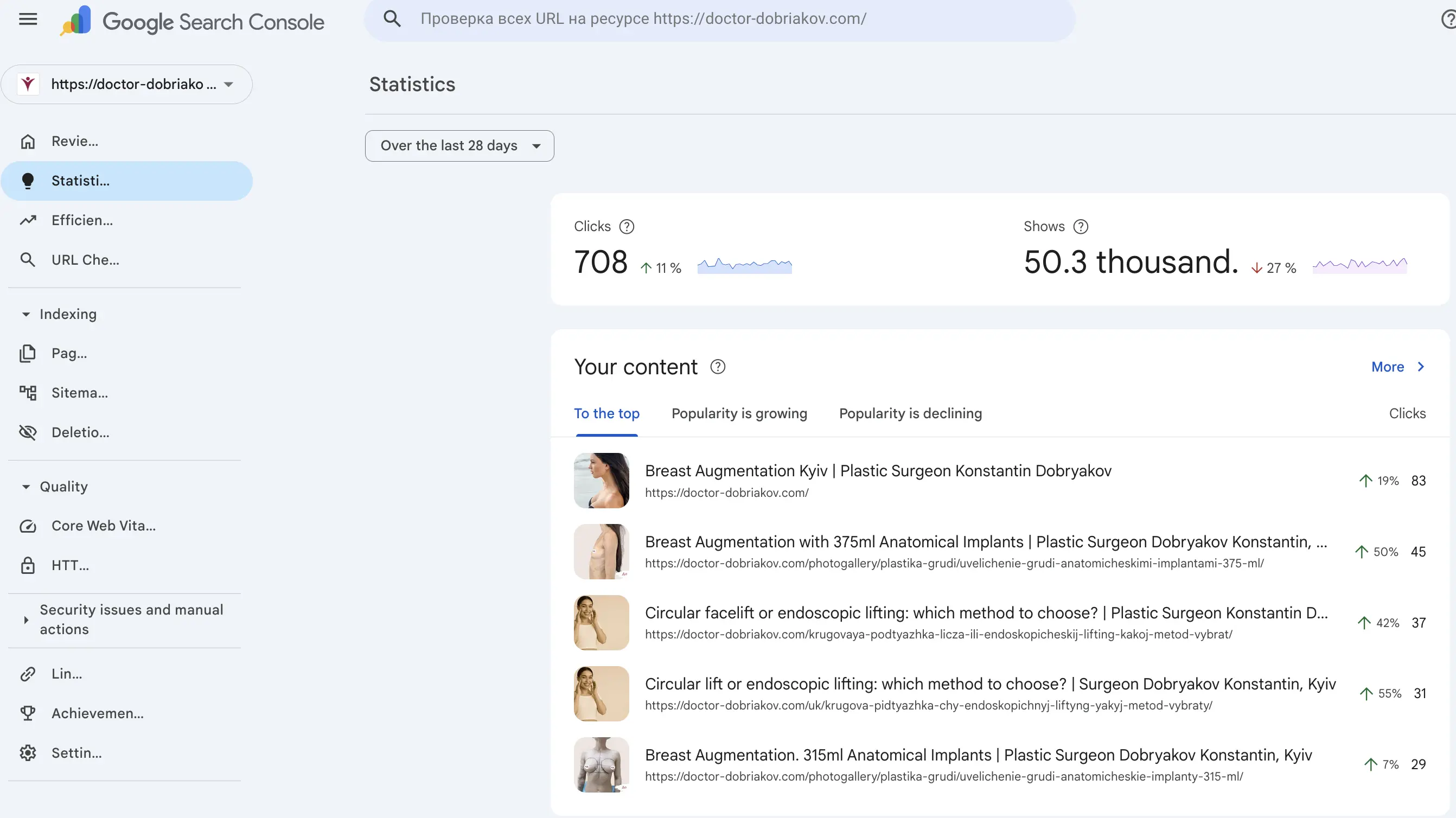
In practice, the problem of untargeted traffic appears even on websites with strong expertise and high-quality design. For example, when working with doctor-dobriakov.com, we saw a typical situation: the site was attracting visitors, but a significant portion of that traffic was not converting into inquiries because it was not closely aligned with clear commercial intent. In other words, people were coming to the website, but not in the volume or with the type of search intent that leads to bookings, requests, or service purchases.
Reason 12. The consequences of cheap or black-hat SEO
One of the most painful causes of traffic decline is the aftermath of poor-quality SEO work. When a website is promoted through cheap links, bots, behavioral manipulation, or other risky methods, the result may be short-term, but the consequences can be long and expensive.
In practice, we regularly encounter websites that are easier to rebuild from scratch than to recover after this kind of “SEO.”
What to do if traffic has already dropped: a step-by-step plan
If a website is already losing positions and leads, the response has to be systematic.
- Identify when the drop started. Open Yandex Metrica and Google Analytics / Search Console. Determine the exact date the decline began and which pages lost traffic.
- Check notifications. Review Yandex Webmaster and Google Search Console for any messages about penalties, indexing issues, manual actions, or critical errors.
- Run a technical audit. Check indexing, robots.txt, sitemap, mobile usability, loading speed, redirects, canonical tags, and duplicates.
- Audit the content. Identify weak pages with high bounce rates, low engagement, and lost visibility.
- Compare the site with the current SERP. Look at what now ranks in the top results for your target queries and compare it with your current structure and page types.
- Review the link profile. Assess link dynamics, donor quality, anomalies, and possible signs of toxic backlinks.
- Create a prioritized action plan. First fix critical technical and penalty-related issues, then move on to content, relevance, structure, commercial factors, and semantic expansion.
Need help? We can help restore and grow your traffic
If your website is already losing traffic and your business is losing leads, it is important not to delay diagnosis. The longer a site stays in decline, the harder and more expensive it becomes to recover.
Our team specializes in SEO growth and recovery for websites affected by traffic loss, search filters, technical issues, and poor past optimization. We work systematically and use only white-hat methods.
What we offer:
- SEO audit with a breakdown of the real reasons behind traffic loss;
- a step-by-step recovery plan with clear priorities;
- SEO focused on results, not on the illusion of activity;
- clear reporting without fluff or vague formalities;
- only safe methods without manipulation, bots, or risky shortcuts.
Instead of guessing why your website has declined, it is far more effective to get an objective picture quickly and start fixing the issues that are actually blocking growth.
If your website is losing traffic, leads, and rankings, submit a request for an audit. We will analyze the situation, show the real reasons for the decline, and provide a concrete recovery and growth plan.