Google publishes official documentation, hosts conferences, shares recommendations, and regularly explains how search works in general. But there are things the search engine will never say directly.
Because it cannot. Because some signals are intentionally not disclosed. Because overly detailed explanations would immediately lead to large-scale manipulation. We have been working in SEO for more than 15 years, and here is what we can confidently say today.
1. User behavior signals matter more than many people think
Google does not disclose the exact weight of user behavior signals in rankings. But in practice, when a page earns a better CTR, stronger engagement, higher interaction quality, and satisfies search intent more effectively, rankings often improve faster than from links or technical fixes alone.
It is important to understand that this is not about crude manipulation, but about genuinely improving user experience.
If a snippet attracts more clicks, users stay on the page longer, continue browsing the site, and do not immediately return to the search results, that is almost always a strong positive signal.
2. Commercial websites have a separate layer of trust signals
Google does not openly call this a separate algorithm, but for commercial projects, additional trust signals clearly matter:
- contact details and transparent company information
- real photos, team, and addresses
- reviews
- prices
- delivery and payment terms
- return policy
- guarantees
- About, Contact, Terms, and Privacy Policy pages
For business websites, these elements are not just design details, but part of the SEO foundation, especially in competitive niches.
3. Google can distinguish real interest from artificial behavior
If someone tries to artificially improve behavioral signals through bots, low-quality incentivized traffic, or questionable schemes, Google often detects it. Not always instantly, but patterns of unnatural behavior, low-quality traffic sources, and abnormal interactions usually leave a footprint.
The result can vary from no effect at all to ranking losses or deeper distrust toward the site. That is why in 2026, betting on artificial signals is more of a risk than a strategy.
4. Content freshness matters, but not for every query
Google does take freshness into account, but only where it logically matters. This is especially visible in topics related to:
- news
- finance
- technology
- law and regulations
- medicine
- updated instructions
- fast-changing markets
But for evergreen content, the date itself is rarely a deciding factor. If an article still answers the query better than others, it can rank for years without major updates.
5. Local relevance is one of the strongest SEO factors
For local businesses, geographic relevance is critical. If a site wants to rank well in a specific city or country, Google needs to clearly understand:
- where the business is located
- which regions it serves
- how well this geography is подтверждена on-site and off-site
For this, the following are important:
- Google Business Profile
- local service pages
- addresses and phone numbers
- mentions in local directories
- consistent NAP data
- reviews
- local links and citations
Without a clear geographic connection, it is difficult to rank strongly in local search results, even if the site is technically well built.
6. Content length is not a direct ranking factor
Google has never said, “write as long as possible.” This remains one of the most persistent SEO myths.
In practice, Google evaluates not the volume of text, but how well the page answers the query. Long, diluted, repetitive material is almost always worse than clear, useful, and well-structured content.
Insight: 2,000–3,000 words with real value are almost always better than 5,000 words written just for volume. But 300 words are often not enough either if the query is competitive and requires real depth.
7. Google can read JavaScript, but relying on that without caution is risky
Yes, Google can process JavaScript. But in practice, JS-rendered content is not always handled as quickly or as reliably as developers hope.
If key content, meta information, links, or important page elements are loaded only after complex JavaScript rendering, you risk:
- slower indexation
- weaker page understanding
- losing part of the content from search
- creating technical issues that remain invisible for too long
That is why critically important SEO content should be made as accessible as possible without depending on heavy client-side rendering.
8. E-E-A-T really affects a site’s visibility
Experience, Expertise, Authoritativeness, and Trust are not just empty theory from Google’s recommendations. In practice, websites with a strong reputation, clear expertise, and demonstrated trust almost always have a better chance in sensitive and competitive topics.
This is especially important in niches such as:
- medicine
- finance and crypto markets
- law
- education
- security
- health
- investments
What works here is not vague wording, but concrete signals:
- authors with real expertise
- transparent company information
- media publications
- case studies
- real reviews
- brand mentions
- high-quality links
- a strong online reputation

9. Domain history matters
If a domain changes topic abruptly, Google sees it. For example, if a site used to be about gaming and suddenly becomes a site about medicine, finance, or legal services, the old domain context can get in the way.
This does not always lead to penalties, but it often means the new project will need more time to prove its relevance and quality, especially if the domain’s previous history was weak, spammy, or unrelated to the new topic.
10. Site speed matters, but only up to a reasonable point
Google takes site speed, Core Web Vitals, and overall user experience into account. But it is important not to take this to extremes.
The difference between a very slow site and a reasonably fast one is huge. But the difference between “good” and “perfect” is much less critical, especially if you have to sacrifice functionality, content, or usability to achieve it.
Put simply:
- the difference between 6 seconds and 3 seconds of load time is very important
- the difference between 2.5 seconds and 1 second does not always produce a comparable SEO effect
First, you need a solid technical baseline, not an endless pursuit of laboratory perfection. In most cases, staying within roughly 3 seconds is already a practical benchmark.
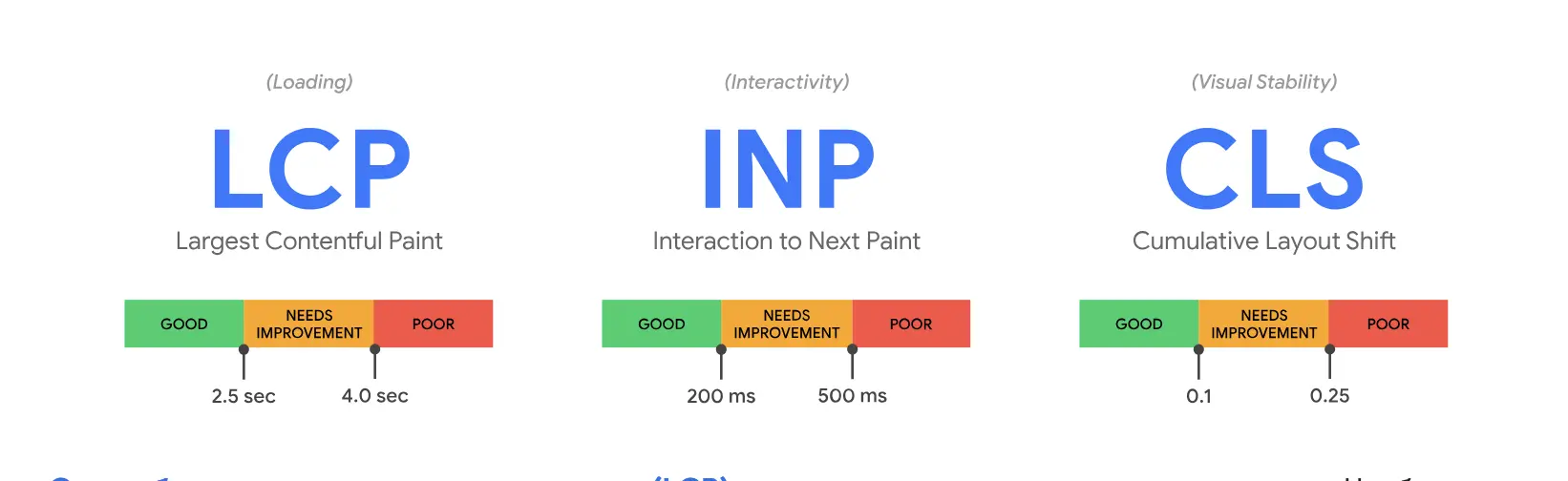
- LCP shows how quickly a user can see the main content of a page. A good result means the largest element on the page loads within 2.5 seconds after the page starts opening.
- INP measures interactivity, meaning how quickly the page responds to user actions. For a good user experience, this metric should be 200 ms or less.
- CLS measures visual stability. If interface elements shift unexpectedly during loading, the user experience gets worse. A good result is considered 0.1 or lower.
These metrics should be evaluated not by isolated visits, but by the 75th percentile of real user data, separately for mobile devices and desktop. That is the correct way to understand how usable the site really is for most of your audience.
What matters in practice
All of these conclusions come not from random articles, but from years of hands-on work with websites across different industries. Google explains a lot, but it does not say everything directly. That is why SEO is won not by those who read the most tips, but by those who know how to interpret signals correctly and apply them to a specific project.
If you want to understand how these insights apply to your website, book an SEO consultation. We will review your project and your site, identify weak points, and build a realistic growth plan without myths or guesswork.